How AI Search Visibility Works (With Real Brand Examples)
AI Search Visibility is the process of monitoring if and how often your brand or site gets mentioned by AI engines when people ask queries related to your category or topic. You can do this manually, of course, searching the prompts and queries yourself in ChatGPT, Claude, Perplexity, Gemini, and Google AI Overviews, but we know that is a tedious process. Using tools such as Yogoo AI gives you an actual measurable trail of who mentions you and what prompts were used. Together, we look through how AI search tracking works, and we will show you examples of what it looks like in practice.
How AI Search Tracking Works
To summarize, tracking works by running the same question through multiple AI engines and checking whether your brand, site, or content appears in the answers. AI search tracking tools like Yogoo AI do this across five engines: ChatGPT, Claude, Perplexity, Gemini, and Google AI Overviews. Every time a tracked question runs, the results show up as either cited or not cited, and if it does get cited, it shows what answer was actually said.
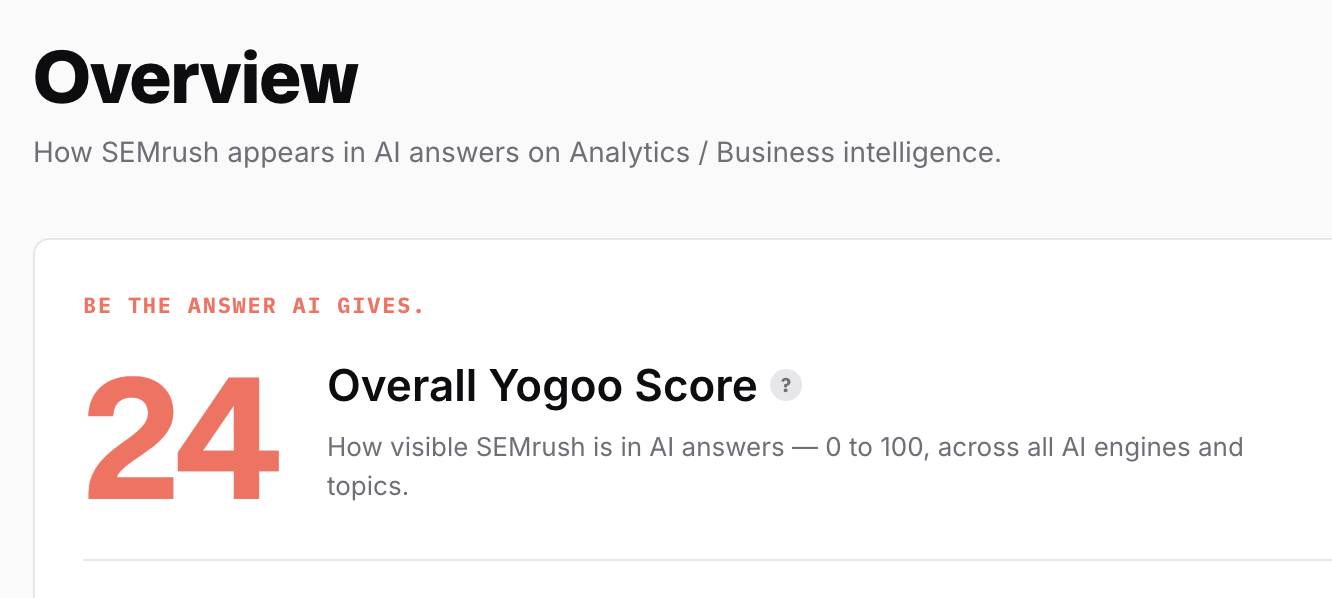
Over time, this will build a pattern instead of a single snapshot. For example, a brand, site, or content might get cited consistently on one engine and never on another. This pattern is what feeds into a single number, which is the Yogoo Score. It shows a 0 to 100 measure of how often your brand, content, or site gets cited across all five AI engines for topics that are related to it.
What Yogoo AI actually monitors
Yogoo’s AI search visibility tracking looks past exact brand name matches. Not every mention counts the same way. A citation can look like a direct brand name drop, a product recommendation, or a comparison against competitors. Yogoo tracks all of these forms, since AI answers often reference brands indirectly inside a broader recommendation.
This is also where the idea of an AI answer engine matters. Each of the five engines generates answers differently, so a brand can be well cited on one and invisible on another. Monitoring across all five is what makes the resulting picture accurate instead of partial.
The Yogoo Diamond
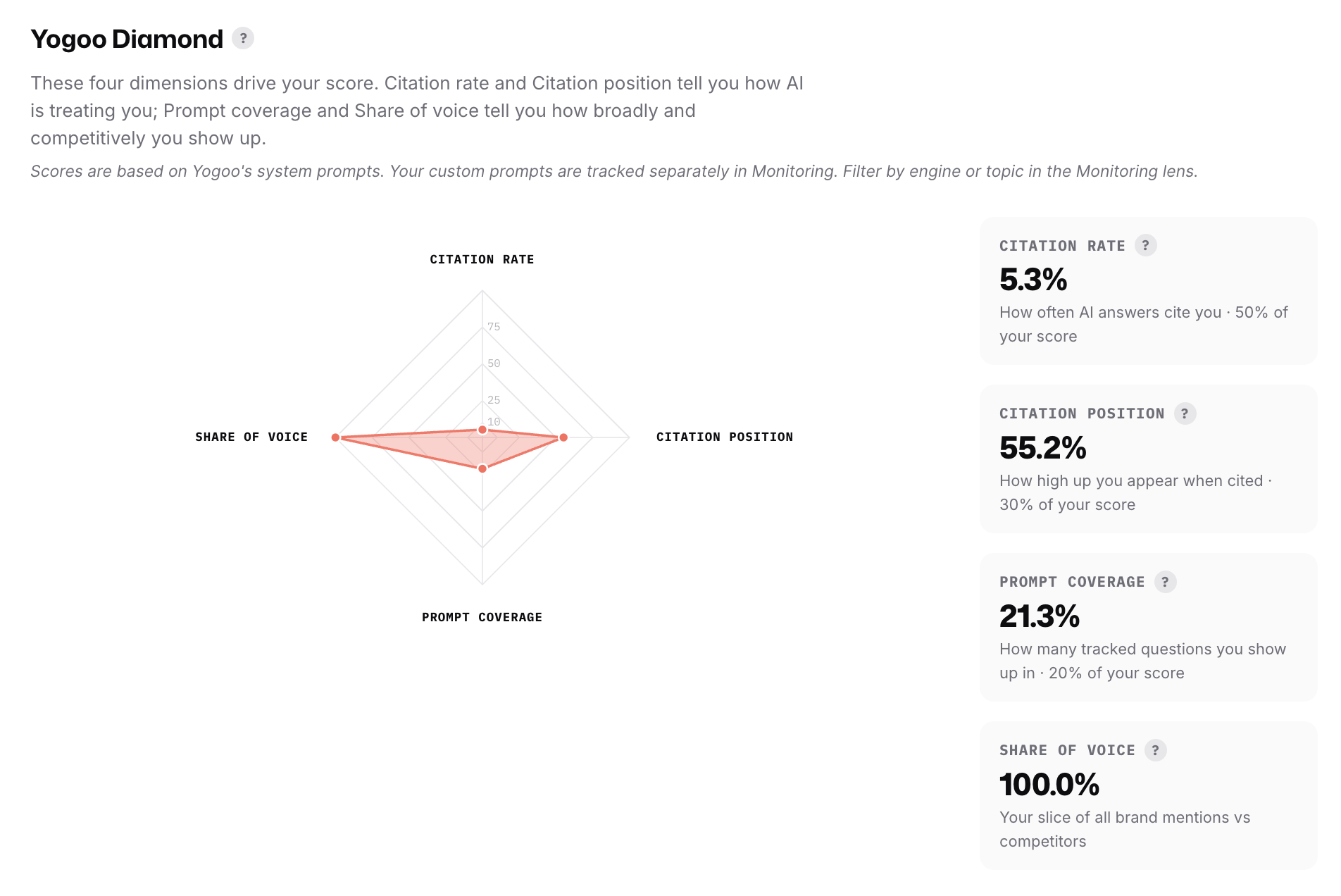
If you want to understand how AI search tracking works in practice, this is it: your AI search visibility score comes from four dimensions, not one number pulled from a single check. Two of them show how AI treats your brand when it does cite you. The other two show how broadly and competitively you show up in the first place.
- Citation rate - how often AI answers cite you. Worth 50% of your score.
- Citation position - how high up you appear when cited. Worth 30% of your score.
- Prompt coverage - how many tracked questions you show up in at all. Worth 20% of your score.
- Share of voice - your slice of all brand mentions compared to competitors, tracked alongside the score rather than folded into it.
These four scores are based on Yogoo’s own system prompts, built to represent how people typically ask AI about your category. If you’re tracking your own custom prompts, those show up separately in Monitoring, where you can also filter by engine or topic to see where the gaps are.
Even the Biggest SEO Brand Isn’t Winning the AI Citation Game Yet
Based on Yogoo’s own citation index (48 tracked prompts in the GEO/AI-citation category, sampled across roughly 309 answers per engine over the last 30 days), citation rates for category questions are low across the board, even for the largest names in SEO.
Perplexity cited Semrush in 5 of 309 sampled answers, across 4 prompts including “best GEO tools for B2B SaaS” and “Profound alternatives for AI-search visibility.” Google AI Overviews cited Semrush in 3 of 309 answers, across 3 prompts.
GrackerAI, a smaller AEO-native platform, actually edged Semrush out. Perplexity cited GrackerAI in 7 of 309 answers across 2 prompts. Google AI Overviews cited GrackerAI in 6 of 309 answers across 3 prompts, including “best AI-search citation tracking platform” and “what are the best tools to track how often ChatGPT mentions my brand.”
These numbers reflect Perplexity and Google AI Overviews specifically, where Yogoo’s measurement is currently strongest.
The takeaway: AI visibility monitoring is still wide open. Being the biggest brand in traditional SEO doesn’t guarantee you own the answer when someone asks an AI engine directly.
Why this matters for your own brand
The examples above show what tracking looks like once it’s running. The same approach applies to any brand: pick the questions your buyers actually ask, check who gets cited across engines, and watch how that changes as your content changes.
If you want the full methodology behind how citations get measured and scored, that’s covered in detail in how we measure AI visibility. For a narrower look at tracking mentions specifically, see how to track AI mentions of your brand.
If you want to see where your own brand stands right now, check your Yogoo Score to get a baseline reading across all five engines.